Thursday, 8 October 2015

The PEN Network Fundraising dinner and dance - measuring success


PEN Network Members, Ateinda Ausarntu, Kathy Nanena, Olivia Haltman, Anne Reid, Yaa Asantewa, Margaret David, Tony Franklin (Photo Bernadette Wills)

Inspiration
There was this young boy, pride radiating in his face. He seemed so serious and studious. He wasn’t with the other children when group photos were taken outside the school. It seemed that he had superimposed himself, wilfully, daringly – like some pertinent reminder – near the shabby Odoi Atsem School sign. A reminder or a prompt. I remember thinking only one thing as I snapped his picture – of Dr Kwame Nkrumah. I thought that humble beginnings can sometimes prepare ordinary people to accomplish great things.


The school teachers have an inspired mission that’s aligned with Nkrumah’s vision. Located in this off track area in Labadi along the coast – the school wants to give its pupils the chance of a Pan-African education that would be a credit to Nkrumah’s legacy. The school receives some materials and sponsors from other well-meaning visitors; especially some Christian organisations. But one of the teachers was keen that the school should be supported by Africans as well, who might have allegiance and therefore support its interest to promote Pan-Africanism.

Often schools on the continent and diaspora regurgitate the curriculum of those countries by which they were once colonised. They teach in the language of those countries thereby relegating local languages to inferiority. Since language is a major part of culture the result is that cultural imperialism continues to impact these communities and perpetuates their underdevelopment. By including Pan African education in the curriculum, Odoi Atsem is at least trying to change the script. In doing so they hope to ground the pupils in their society and community, thereby helping to shape lives in a way that makes sense to them.
I recognised the spirit in that boy’s eyes which for me said something like – ‘I don’t expect charity just opportunity.’

Messrs James Barnor, Eric Huntley and Luke Daniels
Above photos Eddie Osei

Motivation
I learnt a while ago that change can be achieved by small efforts and the will to change. The first fundraising efforts through an Indiegogo campaign raised just over £600 for Odoi Atsem. The school used this to pay some of their student fees, teachers’ salaries and a little maintenance. I’d hoped to raise £1000 that could go further. I had made a commitment to the school from my first visit to help raise funds to eliminate the need for pupils to pay the £6 a term school fees. £6 a term! I learnt that the school needs £5000 to cover its overall costs. This might not seem much to us here in the UK, but it’s significant in an underdeveloped country. This reality of ‘underdevelopment,’ the term preferred by Dr Walter Rodney to ‘developing’ is a tragedy in a country credited as the first to achieve independence in subsharan Africa, making the demands more urgent for others on the continent and the Diaspora to become independent. Why should school children in any ‘underdeveloped’ country be made to pay school fees? What happens when they cant? This is so far removed from Nkrumah’s vision of socialism and it reinforces Rodney’s ideas that Europe underdeveloped Africa to the extent that Ghana does not have a social welfare system that incorporates free education.

So what could we in the diaspora do? A few of us agreed that we could begin to support this school and others that share the Pan-African vision by hosting a fundraising dinner and dance. One way not - the only way, but a start. It would be spectacular, of course. It would bring different groups of peoples, drawn from our respective and diverse networks together. We would encourage them to glam up in their finest attires and step into a gorgeous venue, with exceptional food and great music, all aimed to raise funds.

Planning
There was an art and beauty in the organising. Seven busy people, sparing little time to get together and make it happen - we got on very well and were forced to develop new skills. We had no financial backing, let alone experience of organising something on this scale. We formed the PEN quickly (standing for Promoting Educational Needs), realising that the event needed some name or organisation for legitimacy – members include Olivia Haltman of Oh Services, Anne Reid, Tony Franklin, Kathy Nanena, Margaret David, Ateinda Ausarntu and myself. There was no ‘committee’ set up as our aim was the event – not so much the organisation at that time. That loose format allowed us to fall naturally into our respective strengths and support each other. No one was boss! We were connected by the vision to make the occasion special, and unlike anything we’d been to or thought others might have experienced. The order was tall, but we would aim to reach for it.

Above photos by Eddie Osei

For me, I had wanted to see some folks come out, all dressed up, dancing and freeing up themselves. I felt that with all our social and political commitments, especially Pan-Africanists we hardly get together just to celebrate – but always for some serious issue. Or struggle – which, of course never go away. But surely we can mix and blend, as a way to reinvigorate the work we do towards struggle.

We wanted our guests to feel loved, and know that we’d carefully thought of them and what goodies they might enjoy. We came up with a welcome goody bag, dance off competitions and some raffle prizes. This latter we didn’t want to be slap dash (like hampers of tinned stuff!) and none were. Yes, we’d hoped some airline would donate a flight to Ghana – but none came through despite our attempts. We contacted the Ghanaian embassy – after a whole lot of effort they said the ambassador couldn’t come. In truth what would have been his role? When after all we had active community elders/leaders that gladly graced the occasion with their presence and for which we were so pleased: Mr Eric Huntley, Mr James Barnor, naming a couple and also Ms Wilhlemina Mitchel Murray, the local councillor who heard of the event and was thrilled to attend and support.

Above photos Brian Quavar

Entertainment
Again we had no budget for this - but knew it had to be good. And those family friends who are talented and need exposure got their moment and delighted the audience: J-Unity (Britain’s Got Talent finalists), Alysha and Georgia two lovely young girls who performed a dance routine, making memories that will also build their confidence in creative expression; Natalie David whose smooth vocals gave us the dreamy vibes of ‘somewhere over the rainbow.’ There were wonderful collaborations and ensembles too; the St Michael and All Angels Steel Band played Pan to guests on arrival; it’s a local (to Wembley) group comprised of young and elder members. Amra Anderson, Siayoum Karuma and Ras Prince blasted the drums, contributing the collectiveness of call and response. This all followed the unusual (for this kind of event) but culturally relevant pouring of libation by Priestess Osuyemi Rose.
St Michael and All Angels Steel Band

Priestess Osunyemi Rose pouring libation
Natalie David (singing 'Somewhere over the rainbow)

Alysha and Georgia
Jerome and Jamaal (J-Unity - check out some of their stuff here)
Ras Prince, Amra Anderson, Siayoume Karuma on drums
Above photos Bernadette Wills

Food
And we wanted the catering to be superb. We wanted our guests to not wait. There was some of that, unfortunately. Africans have a way of looking mean when they have to wait for food. And behaving so! I have a bugbear of having to queue for food! In our planning we had asked the venue management about the possibility of table service to our guests, so they wouldn’t have to queue. There’s this curious idea that ‘Africans’ can only manage buffet style. I continue to voice my disagreement, but we were put off the table service idea because – so we were told – ‘it was our first time’ and we ought not to try this apparently novel way of doing collective dinning for such events – for our people! We will stand our ground, should we do this again because I think it’s a false perception that we can only do buffet!
That said, the food was indeed exquisite. Our caterers, Refill provided a wide spread to satisfy a range of dietary needs and tastes. They were professional and I really can’t big them up enough. If you go to an event and the food is wrong – the entire event is! So we’re grateful to Clive and his team for getting it so right. (Have a look see if you can get a feel...)

Banquet by Refill food - browse their website here
Above photos Bernadette Wills

Music
We had an agreement with the venue, run by Mr Fixit that he would also be our DJ (his profession). I cannot explain why but this agreement and arrangement did not manifest as we had expected. On the very day of the event, Mr Fixit said he couldn’t be there. We implored him to recognise our agreement, that we’d bigged him up on our flyers and radio promotions, so he had to attend. He said he would but did not. Instead he installed other DJs with whom we’d had no prior discussions and who were less experienced and did nothing to engage the audience, as he (Mr Fixit) had said he would be doing (as part of the co-hosting). That meant I – the assigned hostess- was speaking too much (I know, I would have probably done so anyway…). He would have had the experience to urge the guests to support the event through raffle sales and other fundraising activities; take part in the dance offs etc.

Photos (from booth) Bernadette Wills)

It also meant that the music, though generally enjoyed by our guests did not always suit the diverse audience. This was a shame because one of the successes of the event was that there was a wide range of people who attended; the youngest being a two month old baby; the eldest probably 87! This is in no way to say our guests didn’t enjoy the music. It could have been much better – as I had anticipated with Mr Fixit on the decks. He has a good Djing reputation.

Dance
Our dance off competition saw guests doing rumba, salsa, cutting shapes and shaking it all to James Brown’s ‘Get up off that thing’ in what turned out to be a combi African/funky style. In that style too we saw some daring attempts to win the competition. Aside from the young brother who dipped effortlessly into a split and bounce, there was an awesome Matrix style, slow wind down to the floor, a skilful move that was seamlessly accomplished in suit no less (click here to see what I mean). During the Salsa there was a tussle between one of its pairs – a sister instructing her (dance) partner that ‘she would lead.’ She didn’t get her chance as he strongly told her ‘no – I’m the man. The man leads.’ The idea with this activity was that people would pay to enter a style. An instructor would show them how, they’d follow and be eliminated should they fail to do the style as expected. The Cutting shapes (shuffle in our day!) was lead by young Alysha and Georgia and monitored by 16 year old Shawana who singled out an able young brother who made the splices and bops look too easy. Few wanted to take part initially – seemed shy, or tight (you had to pay to enter) or didn’t get it! But those who did seemed to have a fab time.
And of course there was the brilliant group bonding dance of CANDY. I squashed myself in and had to focus to not bump into bodies or trod on toes. It was great. See it here.
Superb photo shot by Eddie Osei
Above photos Eddie Osei

Dressed to impress
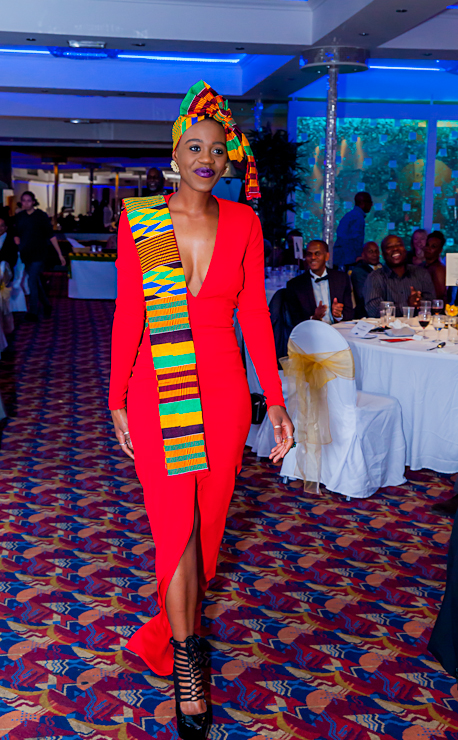
The surprise best dressed male and female activity was won by those guests who we thought looked stunning, though in truth all the guests had made a great effort. I had all sorts of fantastic images in mind when I was thinking about how our guests would look – epic! And there were some amazing outfits; one of the winners (Desmond) looked so so fine in his silky tunic. And model figure Shanice, in her hugging long red dress over which was draped a piece of Kente, matching the big bow on her head also won for making a brilliant effort. We hope by this gesture others will feel inspired to look sharp in their outfits, whether tailored or sought and bought if we do it again. As for my dress, this was made, I’m proud to say by a local seamstress called Celia – who met my last min.com challenge and did it in five days! Why the last min? Too busy with the organising, don’t you know.
Above photos Bernadette Wills

Did it work – was the fundraising mission accomplished?
The happy reports and feedback from the majority of our guests and the calls for a repeat of the event; even the generous donation by sponsors like Pauline Bennett of Project West who also came with two full tables and a further number of dance only tickets; the evidence through smiles and ready involvement of those who came all speak to the success of the fundraiser. But the big question bulging lips was whether or not we’d raised our expected or even enough funds. No. Is the simple answer. The income streams we’d envisaged didn’t fulfil our expectations. The bar, the raffles, the dance offs, the blind auction – the little brown envelopes (only one guest used this!), didn’t generate what we’d hoped. Those of you who have organised fundraisers like this, I’m sure will understand some of the issues and perhaps WHY it didn’t quite generate in the way we imagined it would, despite the evidently wonderful experience our guests had, many of them singing praises for the well organised event.

Photos Bernadette Wills

Sour notes
A major reason why the event was not financially successful, though it was socially, is that the venue manager stitched us up. We relied on the experience and advice of Mr Fixit (I’m using this medium to enable me to be frank because I feel his antics are detrimental to community development and needs to be addressed). Promises made, for example, that he would promote the event to his networks (since this is ‘what he does’) and so bring us more ‘dance only ticket sales’ were not fulfilled. Instead of the expected and potential 200 dance only tickets (for which we’d budgeted following his advice) there were no more than 50. He didn’t promote the event, at all, as he was not intending to be there. This he told us on the same day, a few hours before we were due to be setting up.

Those extra guests, who might have bought from the bar would have given us the sum we hoped to raise. Fixit demanded upfront payments for everything! Members, having now committed to holding the event at the Royal Lounge were forced to source funds from our own pockets for items that should have been paid after. This was despite our negotiation with the Caterers who was happy for us to pay the balance (of their part) after the event. The Venue had given us the total budget, you see, and entrapped up so that we weren’t expected to communicate with the ‘third parties’ (one being Refill). We were warned that ‘Fixit’ is all about ‘business’ but that he was kind of ruthless didn’t come into our thoughts as one of the members knew him and had recommended the Royal Lounge based on her experience of him. Toilet attendants, not necessary though we went along with it were asking our guests for money – this was not agreed with us and it seems probable that this was their means of income for that night as opposed to the fee we’d been charged for them. Further, we had asked Mr Fixit how we should budget for the bar. He gave us figures that we now know were grossly exaggerated.

Photos Eddie Osei

We take some of this on the chin as it were. Accept the lessons and our own culpability. We are thankful for the experience and will reassess, rather than regret. We wouldn’t have been in the conscious position we now are. We were totally ‘green’ and ‘vulnerable.’ I’m aware some fundraisers are fronts for exploitation; aware that unless you organise something you don’t see the behind scenes nightmare and might assume, because it ‘looks good’ that all is well. Sadly all is not well, when well-meaning ventures are sharked by those who know the ‘ropes’ and capitalise on the vulnerability and inexperience of others. This hinders community advancement, quashing the humanist principles I hold dear. For our community to be transformed we need to stop exploiting each other in the name of grabiliousness and greed. It would also benefit all our efforts to respect the process of organising – many of our would-be guests took time to advance payments, leaving it to the last minute. I think we can change this script too. What we didn’t want and didn’t achieve very well was making anyone wait for anything. This we must work on (lose the attitude that tardiness is a ‘black people’s malaise’) because it’s an important matter of discipline.
In all this we are grateful for the realisation that ultimately we didn’t do our due diligence on several fronts. We are wide awake now and accept, as one member expressed beautifully ‘post-mortem don’t bring back dead…’ but it can identify cause.

Above photos Eddie Osei

Sweet notes

Imagine, in one room more than a hundred people (about 150/60) brought together to support a single issue. Some had no particular idea what ‘Pan-African’ means in its political sense. That it is a symbol of unity, which we all recognise we need now as ever. Many had never heard of the school, which name and location they now do. Some level of consciousness was raised, therefore. Sponsors who gave us space to promote on their radio shows, and those who volunteered, the entertainers who asked for no payment (though next time we’d love to afford this); the team spiritedness of the PEN Network members; the sumptuous banquet; the tables named after an African Icon, or great Pan-African leader, with a piece of Kente draped across; that the 19th September was especially chosen to honour Kwame Nkrumah whose birthday it was; the feel of being in the midst of a large loving family were all signs that the event was something special. A glimpse?

And of course, we will advance £2000 to the school, as this is the sum we had hoped to raise for them. We know there are many who will support us and fulfil promises to donate. Will we do it again? That question is answered by the realisation that with every struggle there are lessons to learn and that transformation begins with readiness of a few ordinary people to take on struggle. So see you at our next venture…


Photos Eddie Osei
Our press statement, on the website (thepennetwork.org.uk) gives more information about the event, especially our big thanks to supporters and sponsors. Do have a look and help us do this thing...

Tuesday, 1 September 2015

Ancestors and deities: an August of spiritual aliveness

Shrine built to honour Osun

When I was younger I overheard certain conversations between grown ups that both baffled and terrified me. In my African Guyanese home there was always some heated political talk that favoured PNC politics; bemoaning the loss of Burnham, how he'd be turning in his grave because of the way the country had turned out contrary to his apparent excellent leadership; as though his earnest work was being undone. They spoke about a back in the day when Forbes Burnham had sanctioned shortages of basic commodities (flour, Irish potatoes and so on), which was considered a good economic move on his part. Burnham was spoken of as a champion of the (African people), a hero - I imagined the great orator he was when they spoke about him. It would take years before I realised that not all Africans considered him a hero - and when I learnt of the fate of Dr Walter Rodney, who attempted to unite the Guyanese masses regardless of race I had to rewire my mind from the Burnhamite programming.

Along with the racially biased politics there was OBEAH! Somebody - or several - were always 'working obeah' on somebody else for some bizarre reason. And the thing seemed to work - there were always victims - a house burnt down, babies still born, or sold (through some accident that killed them), man taken away from his wife (who might mysteriously leave her to live with another woman - the probable one that did the obeah wok, he works his life away and gives the new woman all his money, doesn't have any time for friends or blood family) and so on. Then there was the bacoo - wicked, miniature creatures planted or owned by someone which either 'worked' for them (bringing them riches, transitory or longlasting depending on how well they were'fed') or which wreaked havoc on their enemies. Bacoos were described as something/beings that could be seen by those who had eyes to - often children could see them. The very idea of these things frightened me; they were of and out of this world and had some impact that was real. Yet worse that these was Ole Higue - a monstrous woman that preyed on innocents - children/babies; she turned into a ball of fire as she prowled through the night to do her work. If they're not protected by some very smelly root called asafeoetida or a piece of blue cloth Ole Higue would 'suck' the child like a vampire. Visible marks appeared on the child's body in the morning which signalled that they had been victims of Ole Higue.
Bottom part of shrine for offerings, Osun loves honey, yellow and white flowers, cinnamon, pumpkin seeds etc.

Countless stories like these I overheard - who and who did the 'sucking' or had it (the ability to do it or just 'it' the big mysterious 'suck') that seriously scared me. Naturally I had no aspiration to return to Guyana if these conditions of negativity were awaiting me there.

Comfa too was often spoken about - sceptically - curiously, how so and so head 'does hold he/sheh.' It would take years before I got the hang of this head holding sheh/he thing - which meant that the person would go into trance (become spiritually possessed and dance). Some of the possessed became mystically acrobatic, doing somersaults, dancing on their heads, falling fitfully to the ground - any possible and seemingly volatile outcome was possible - it didn't matter what their age - it could happen to anyone. Some people 'stayed away' when drums were knocking to avoid the randomness and potential of going into trance or being overtaken in this way by spirit. And who were the spirits that took them? Sometimes they were recognisable, as a familiar (the possessed dancing in a way similar to a deceased relative) other times it was an unknown spiritual entity. I suppose this explains part of the collective fear of it.

There were odd occasions when it was obeah (man or woman) who would be sought to deal with some serious illness when medical intervention failed. So if nothing else I soon understood that obeah worked both positively and negatively. But it would be some time before I 'read' it that way. And 'reading' it literally became my life - for it was the basis for my postgrad studies at university. The narratives had an unwitting purpose!

Reflecting Osun

In any case before my conscious rereading of African derived spirituality and practices I was baffled by the negative emphasis of these discussions I overheard. At the time I never questioned my elders, I just listened, absorbed and stayed silent in my fear and ignorance.

Fast forward through years of processing these narratives; assessing my own experiences of spiritual and natural signs; realising that the negative emphasis was unfair and had a historical basis I'm now in a comfortable place of acceptance or realisation. Obeah is a power, this is true. Like all power it has positive and negative uses. The effect of any given power is connected to the force behind it - or the energy that drives it. Intention yields the outcome - as 'willed action'thus making it 'manifest.'In the Yoruba tradition of Ifa, this power or willed action is called 'Ase' (a - sheh). It means 'so be it' or 'it is so' a bit like the 'Amen' Christians use (leaving aside its connection to ancient Egypt of course). I have observed a growing appreciation of Ase, not least from myself but many others who are opening to the way of spirit and the spiritual traditions of African ancestors.

Another beautiful Osun impression

It's not surprising, given my own situation of elders speaking sceptically and negatively about our spiritual experiences/cultures and traditions that the 'opening' has taken so long. Rather the reconnection, even 're-cognition' has. The dehumanisation of African traditions and culture through European conquest, slavery and colonialism is chief among the reasons for this. And I must add that I didn't find comfort/comprehension either in the biblical narratives that were also hotly discussed in my home. Symbols of witchcraft - the witch of Endor who roused Samuel from his grave for example (and other death to life mysteries); divine wrath - when Lot's wife was turned to salt or Jehovah sanctioning his favoured Jews to take over another group of people's land (mirrored in reality by the Israeli/Palestinian never ending tyranny); that moment when God commanded Abraham to kill his son Isaac before sadistically changing his mind and said kill the lamb instead (the lamb! as a burnt offering!); the immaculate conception (boggles my mind if I read it literally) and images of Christ nailed - nailed to the cross (if I read it literally) all frightened and fascinated me just as the real life stories my elders spoke about. The emphasis was different, however. There was an acceptance for one thing that the latter narratives were in order - pregnancy without sexual intercourse was accepted as 'natural' since the baby was 'Jesus' the saviour who would have to die for our sins. Sins? These too had elements of terror in them - because one had to believe that I was born a sinner. How? Why? I fled my confusion by conceding to the call of spirit one day and here I am!

This stunning work depicting Osun I found on Pinterest, but go to Alvinepps.com

The mental crises meant I have spent a good number of years trying to understand and connect with my ancestral traditions. Where others might have (re)turned to 'the Christian God' whom I was brought up to 'fear' (!) during this period, I opened to my ancestors. I still had the perception of 'god' but I could 'hear' my grandparents (Ma and Pa) communing with me and I accepted their 'voices.'

Emancipation in Guyana - takes place on August 1st. It's a time when African Guyanese (in some cases other Guyanese) celebrate, they wear African clothing and congregate at the National Park. Here in the UK, the Carnival (happening as I write) is held in memory of African ancestors, their struggles for liberation and justice (linked to the Notting Hill riots). Every year in Yoruba, more specifically in Osogbo there's a big festival honouring the goddess Osun, a well worshipped Orisa. I can't say exactly why but this August I have felt the reverberations of ancestral spiritual energies which maybe reflect a shift in consciousness.

Following a ritual to honour Osun I collaborated with an Osun priestess to organise a workshop introducing others to African Traditional Spiritual practice. A few of us had been to the river and some wanted answers about what the ritual meant - what were some of the symbols. The workshop was supposed to answer some of this.

Group at river ritual in July

It took place on Saturday 29th, It was focused on the Orisa Osun; included pouring libation (to Oludumare, Orisa, ancestors), collectively building an Osun shrine, sharing introduction to Ifa (spiritual/religous tradition of Yoruba) and the power of Orisa, especially Osun whose vibration we welcomed. By this I mean spirit manifested powerfully and was embraced. The energy was magnetic, as one of the sister who experienced it says: 'I felt like I had encountered a rebirth.'

The positive response to the workshop revealed the need in our community to reconnect with our ancestral wisdoms, our right to be fearless champions of these, to take pride in them - and they are as varied as we are on the Continent and the diaspora. Though varied, they speak one unifying truth. The individual is invested with spiritual power (Ase) to be in tune with forces of nature (Orisa/deities in the case of Ifa) that enable us to align with our higher purpose. That higher purpose is DIVINE. Let's make no mistake and when we speak boldly of this divinity - we are reconfiguring ourselves to become empowered.

The Ifa tradition encourages the development of 'good character' a deeply, ethical and moral calling or quest than it might appear to be. It's not easy to have good character (Iwa Pele, as it's called in Yoruba). Ifa tradition is also about self transformation. Guided by our inner being or conscience, which Ifa calls Ori we begin the journey of aligning fully with the purpose we've each come (returned) to do. Balance and harmony and the collective responsibility for evolving our humanity are deeply woven into the Ifa tradition.

With Priestess Osunyemi connecting with the Osogbo festival in Yoruba, August 20th

Osun, one of a number of Orisa represents many wonderful aspects of life - love, fertility, abundance, sensuality are just very few. She ameliorates; her honey smoothens, her cool water, embodied in the essence of rivers is soothing. So the earnest devotee refers to her as they would any loving parent when the need arises to be tenderly nurtured, and assured that all will be well, since they appear ready for healing and humbled. We bring her the gifts she adores in exchange for the grace, beauty, abundance, peace etc that she'll provide. We love her as she loves us. We want to exude her essence, spreading sweetness and joy as we journey through life; touching the lives of others gently but powerfully; enriching ours by reflecting beauty and creativity. Yet - she is not to be confused with a 'soft', 'wet' weakling of a woman. She is a fierce defender (as any woman would their children who needs her protection); she demands respect - for that's a natural right; if you wrong an Osun initiate/devotee - genuinely wrong someone that has shown you nothing but love - then naturally a fierce, warrior/disciplinarian side unleashes. So we take care in our relations with each other - brother to sister, sister to sister, brother to brother and so on.

The day was a blessed one. I give thanks to the energies that prevailed; the positive forces that joined us. To Esu for opening the way, to Ogun for clearance, to Osun for descending, for the ancestors (egun) for being with us always.


At the workshop on African spirituality Saturday August 29th

I mark the contrast between this expression of our ancestral practice, which I see as positive and empowering and the psychically confusing narratives about the world of spirit and spirituality which I was exposed to as a child. I continue to hear these negative impressions about obeah and comfa and so on, but the difference is my own understanding, my own interpretations. I still hear that so and so (especially in the part of Guyana my family are from) get 'bacoo' or went to the obeah man/woman to do this or that to their neighbour, and I wonder about the use of this power in negative ways - to harm another. This appears to be a wholly disfigured understanding of the purpose of our ancestral practices. Of course where harm has been done to you, one would defend one self by any means necessary as we saw with Boukman and Dessalines. In other words, use what ever form of POWER to effect real change rather than wasting the energy on a petty problem which is harmful to individual and collective community empowerment. Herein lies the most purposeful benefit of honouring our ancestral spiritual practices and traditions.
The following are shared notes from the Interactive Workshop on African Spirituality - emphasis on Osun


Purpose of practising African Spirituality : to reclaim individual and collective power: so that Africans as a group of peoples are “empowered and energised from within and get their total energy from their own self source” (from a paper by Chief Sangodasawande presented to the symposium on Ifa in Trinidad in July 2015).

What is Ifa? It is the traditional 'religion' of the Yoruba. It embeds an entire system of transformation. It allows us to take from it that which will benefit our life/spiritual purpose and destiny, working in harmony with the forces of nature to achieve and maintain balance. It involves a complex system, called divination through which mankind is able to align with their life purpose/destiny in pursuit of maintaining balance and order.

What is Orisa? The word Orisa translates as ‘select head.’ In Ifa Orisa refer to spiritual forces that guide consciousness. There are several Orisa in the Ifa tradition. Each have their own characteristics, powers and prohibitions.

Divining with cowries

Your Ori: the word means ‘head.’ It relates to ‘consciousness.’ Being guided by and aligning with one’s Ori is the means through which transformation (of self and spiritual development) takes place. The development of ‘good character’ is of chief importance for Ori:‘Ori ki buro ko fe de ale, ile ti iwa nikan lo soro (transl: no matter how bad a person’s destiny may be, there is an amendment; but the more difficult to amend is an individual’s character.’)

Divination then may easily be considered the means by which we transform our lives and reconnect with our spiritual purpose/destiny. It allows the individual independence but encourages them to be guided by their Ori (head/consciousness), which in turn enables transformation and rightful living.

There are many ways to divine. It is to do with reading any one or many signs that will allow us to decide how to adjust our lives to ensure we align with our destiny. In Ifa this form of divining is done using cowrie shells. There are 16 original signs (16 is considered a magical, cosmological number) which have 16 possible outcomes each. Totalling 256.


Offerings: (or Ebos) are specific to each ORISA. OSUN, for example, loves honey. We offer this to her in ritual practice, along with others that are particular to her.

ASE O (pronounced – a-sheh) is like a note or sounding of spiritual power. We use it as an invocation to EMPOWER the energies/prayers/requests we make.

Who Is Osun?

Osun is the river deity of Yoruba tradition. She is the owner of cool sweet waters which she uses for cleansing and healing. She is the orisa of fertility, creativity, sensuality and feminine essence. She is a healer and herbalist. Women appeal to her for children, to cure gynaecological problems and to heal ill babies. She is an intelligent and wealthy business woman. She is also a warrior and a leader of powerful beings (Ajes or witches)
She divines with 16 Cowrie Shells or Merindalogun which was taught to her by her husband Orunmila (another Orisa).

Osun is powerful and empowers all persons who call on her. The Ifa odu (sign/narrative) called Ose Tura demonstrates the power of Osun. It states that Olodumare had sent 17 Irunmoles (divinities) to the world, 16 men and just 1 woman which was Osun. She was ignored by the men when any important decision was to be made. This caused disorder as everything fell apart. The men went to Olodumare to find out the cause of the drought and barrenness in the world. They were told that they had left Osun out of everything. The men had to appease Osun. Osun said that if she gave birth to a son all will be forgiven. They prayed and Osun gave birth to Ose Tura which is the orisa Esu. Esu is the divine messenger who takes our prayers to Olodumare. Therefore reverence is given to Esu first before any spiritual work is done.

Osun is the good mother who demands homage, respect and supplication if her powers are to be placated and accessed. Osun is a gentle warrior who uses wisdom, diplomacy and sweetness to solve disputes. This characteristic of Osun is shown in an odu from Nigeria which tells the story of a town of women who had rebelled against the men, the men complained to the king who sent the 16 male deities (Irunmoles) to capture the women. All the male deities failed to capture the women so they eventually sent the women. Oya went first but she was defeated. Yemoja was sent, then Osun. Osun went to Ifa and after making necessary sacrifice she went to the town of the women beating a calabash and singing. “Sewele, Sewele, she sang, Osun is coming to play.” Osun does not know how to fight Sewele, sewele. The women saw her and joined her singing. They dropped their weapons and followed her back to the town.

As Yeye Osun, the good mother of women and men, she is responsible for the continuous engagement and harmony of both sexes. She is the mother of fertility, intimacy and the male and female relationship. If men and women were not having sexual relationship procreation would not occur to bring forth children.

African traditional spiritual practices are as varied and vibrant as the peoples of the continent and in the diaspora. However, there is a single point of unity between them. This relates to the individual’s responsibility toward their alignment to spiritual purpose. When the individual pursues this alignment they activate the ‘consciousness’ that is referred among other names as GOD.

Click here for drumming and dance
And here

Shout Out.